
AI-Enabled Data Model

Find out whether your asset data is ready for AI agents to use, without a human explaining it first.

COSOL's AI-Enabled Data Model sets the standard. The Benchmark Assessment measures your data against it, ranks each gap, and tells you what to fix first.

Request an Assessment
Man overlooking equipment with data shown on ipad in factory.
12
Principles your data model is benchmarked against
4
Categories covering naming, structure, business logic, and transparency
25+
Years of data and asset management delivery experience

AI Readiness Benchmarking for Organisations Running Maximo, Ellipse, or SAP PM

COSOL’s AI-Enabled Data Model is not a generic AI-readiness checklist. It is built around 12 specific principles across 4 categories, developed from what actually breaks when AI agents are pointed at real Maximo, Ellipse, and SAP PM data.

COSOL assesses where your data model currently sits against these principles and gives you a clear, prioritised set of gaps, some you can close internally and some COSOL can help you close. The team behind this benchmark carries more than 20 years of data and asset management expertise, and COSOL itself is independently ISO certified.

Our three staged approach

AI-Readiness Benchmark Assessment

COSOL assesses your current data model against the 12 principles across naming and semantics, structure and relationships, business logic and completeness, and layered transparency. Each principle is ranked Strong, Partial, or Gap, so you know exactly where an AI agent will return a correct answer and where it will guess.

Prioritised Gap Roadmap

You receive a clear, prioritised list of the gaps identified during the benchmark, split between what your team can close internally and where COSOL's specialists can help. There is no obligation to engage COSOL further to act on the findings.

Scheduled Output Testing

A data model that is correct on day one does not stay correct by accident, since source systems get upgraded and failure codes get reclassified. COSOL builds a library of known business questions with known correct answers, run automatically against live data, so drift gets flagged and fixed before anyone acts on a wrong number.

What Makes COSOL Different in AI-Enabled Data Modelling
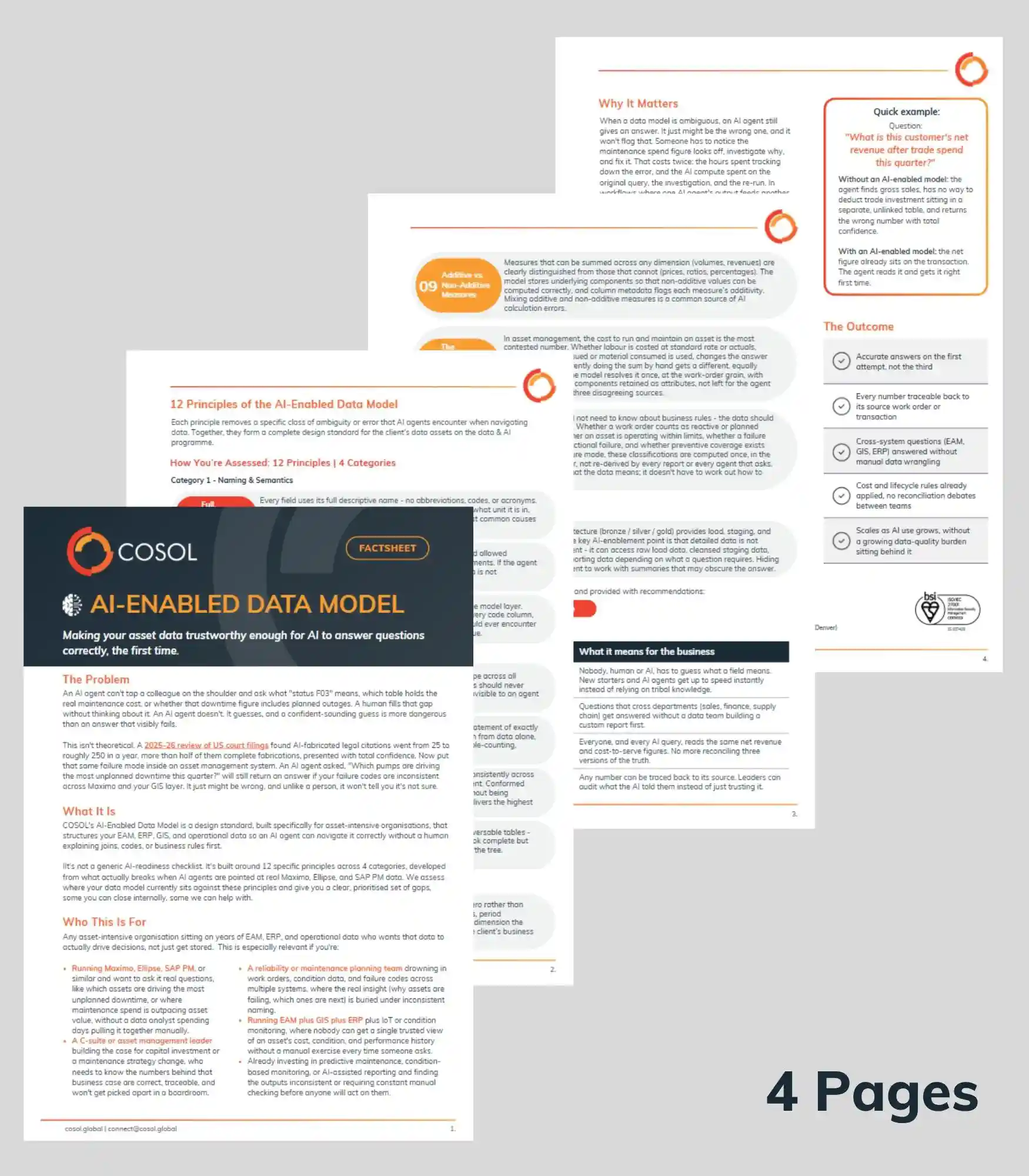
Category 1 - Naming & Semantics
01
Full, Unambiguous Field Names
02
Rich Semantic Metadata
03
Resolved Codes & Statuses
Category 2 - Structure & Relationships
04
Consistent Field Linking
05
Explicit Grain Declaration
06
Conformed Dimensions
07
Explicit Hierarchy Tables
Category 3 - Business Logic & Completeness
08
Temporal Completeness - Date Spine & Fiscal Calendar
09
Additive vs. Non-Additive Measures
10
The Contested Number, Pre-Resolved
11
Business Logic Embedded in the Model
Category 3 - Business Logic & Completeness
12
Multiple Layers - Detail Preserved, Nothing Hidden
Built Around Maximo, Ellipse, and SAP PM
The 12 principles behind this benchmark come from what actually breaks when AI agents are pointed at real Maximo, Ellipse, and SAP PM data, not theoretical data models. COSOL's specialists have worked inside these systems across mining, utilities, infrastructure, transport, government, and defence for 25 years
A Framework Built From Failure Patterns
COSOL's AI-Enabled Data Model is a proprietary model that is structured around 4 categories and 12 specific principles, covering naming and semantics through to layered transparency. Each principle carries a direct business consequence, so a Gap ranking tells you what will actually go wrong, not just what is technically missing.
Independently Certified, Accountable Delivery
COSOL is independently ISO certified, and the benchmark methodology draws on more than 20 years of data and asset management delivery experience. COSOL stays accountable for its recommendations, whether your team closes the gaps internally or COSOL helps close them.
Thumbnail of the downloadable document - AI Enabled Data Model Factsheet

DOWNLOAD OUR AI-ENABLED DATA MODEL FACTSHEET

Learn how COSOL's AI-Enabled Data Model helps asset-centric organisations structure their EAM, ERP, GIS and operational data so AI agents can navigate it correctly, without a human explaining joins, codes or business rules first. Discover the 12 principles across 4 categories we use to benchmark your data model and show you exactly where the gaps are.

Is This the Right Time for an AI-Enabled Data Model Benchmark?

Most organisations reach for this conversation once AI-assisted reporting or predictive maintenance is already in motion and the outputs are starting to raise questions. The following situations are common triggers.
You are running Maximo, Ellipse, SAP PM, or a similar system and want to ask it real questions, such as which assets are driving the most unplanned downtime, without a data analyst spending days pulling it together manually.
You are building a business case for capital investment or a maintenance strategy change, and need the numbers behind it to be correct, traceable, and defensible in front of a board.
Your reliability or maintenance planning team is working across multiple systems with inconsistent naming, and the real insight into why assets are failing is buried under work orders, condition data, and failure codes.
You are running EAM, GIS, ERP, and IoT or condition monitoring together, and nobody can get a single trusted view of an asset's cost, condition, and performance history without a manual exercise every time someone asks.
You are already investing in predictive maintenance, condition-based monitoring, or AI-assisted reporting, and finding the outputs inconsistent or requiring constant manual checking before anyone will act on them.
Engaging early, before AI-assisted reporting is scaled across more of the business, means gaps get caught while they are still cheap to fix. The benchmark assessment is the starting point.

FAQs

Find out whether your Asset Data is Ready for AI Agents to use reliably

Book a no-obligation benchmark against the 12 principles and get a clear, prioritised picture of your gaps.
Request a Benchmark
Assessment