
Asset Information Ecosystem Roadmaps
A roadmap helps an organisation go from where they are in their asset management maturity journey to where they want to be by establishing a strategic approach to collection, management, reporting and overall governance of asset information through systems and technologies.
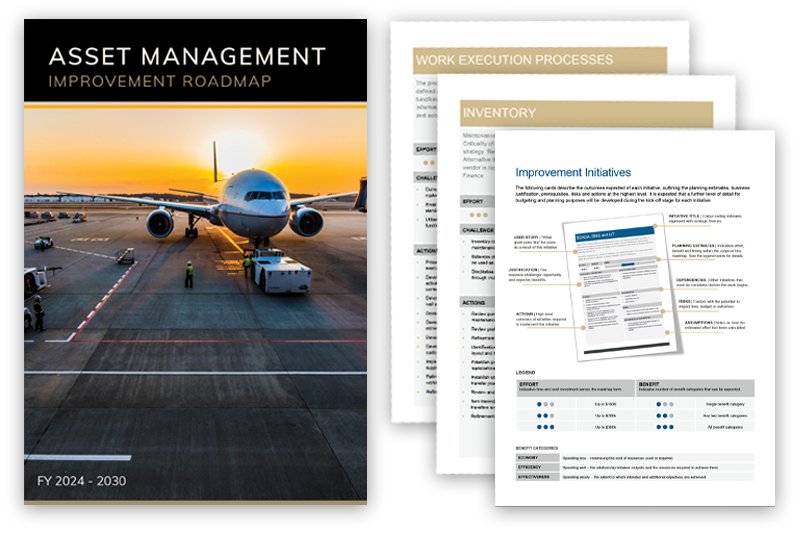
Mapping the journey to asset management maturity.
COSOL has found that organisations operating without a strategic framework for reviewing, approving and prioritising change initiatives come to rely on inefficient, ad-hoc development efforts. This results in double handling of data, increasing maintenance of that data, inefficient integrations, poor returns on systems investments and squandering of available budgets.
To ensure an organisation's asset management change programs align with their business priorities, Asset Information Ecosystem and Optimisation Roadmaps are developed specifically for the organisation to provide clarity of vision and consistent delivery of improvement initiatives for their asset information systems.
Roadmaps are detailed and chart a journey of maturity-building initiatives and actions that are implemented in stages over time to help organisations reach their identified goals. Developed in consultation with key stakeholders, roadmaps begin with a current state assessment and result in a strategic document that defines the path to the desired future state.
Depending on the organisational needs, COSOL's roadmaps can include the people, process and data elements of an asset management.
The Benefits of Optimisation
Waves of data are generated in the course of business every day. More data is good data – but only if it can be understood and interpreted efficiently and dynamically to bring greater insight into asset performance.
Optimising the asset information ecosystem is about combining data with the tools that provide actionable insights, resulting in the potential to improve every function within the organisation. With integrated visibility, control and automation across business and technology assets, you can achieve objectives and maximise the value of all assets supporting the operation.
Optimised asset management operations experience the following:
- Increased asset availability – Reliability provides the basis for improving service delivery and growing revenue from the same asset base.
- More timely and precise interventions – Improved productivity and reduced material use.
- Increased asset lifespans and reduced downtime – Higher utilisation and more effective investment in facilities/assets and inventory over time.
A Structured Approach To Continuous Improvement
Each Asset Information Ecosystem Roadmap is developed through three stages:
- Current State Assessment
A collaborative, exploratory investigation is undertaken to develop a shared understanding of current asset information ecosystem performance, including identification of any challenges, as well as ambitions for future changes and innovation. This stage determines the direction of future stakeholder consultation. - Stakeholder Workshops
A series of workshops are held with stakeholders to clarify, learn, challenge and consolidate a path forward that aligns with corporate strategies and agreed continuous improvement delivery timeframes. These workshops ensure the roadmap reflects the needs and priorities of the organisation and all stakeholders. - Improvement Roadmap Documentation
The intelligence gathered is used to produce a finalised Asset Information Ecosystem Roadmap report. The report outlines a forward plan for asset management information system development that allows an organisation to communicate system priorities across the business and identify how opportunities relate to each other. It also establishes high-level timeframes to keep stakeholders on track and working towards common goals.
Once the roadmap is endorsed across the organisation, it can be used as a foundation for the successful delivery of a Continuous Improvement Delivery program.

How Metro Trains Sydney Keeps 70 Million Journeys on Track with COSOL’s AMaaS

If It’s Not In The System, Did It Even Happen?
IMPROVEMENT FRAMEWORK
Keeps implementation efforts on track with an agreed program of initiatives, accommodating technical dependencies and business priorities.
SPECIALIST TECHNOLOGIES
Relates primarily to specialist EAM systems (asset and works management) and Esri ArcGIS (spatial and GIS) technologies.
AIDS ASSET MATURITY
Identifies improvement initiatives and stretch targets that will build capability in these key areas and improve asset management maturity across your organisation.
ELIMINATES AD-HOC IMPROVEMENTS
Builds a sound asset management information system foundation that reduces the risk of ‘rip and replace’ in future initiatives.
ENGAGES STAKEHOLDERS
Develop a common understanding of the path forward, bring key stakeholders into the decision-making fold and share in change benefits.
MAXIMISES THE BENEFITS OF DATA
Increase asset management maturity by managing data like an asset, understanding data gaps, leveraging data improvements and using quantitative data to drive decision-making.

DELIVER ON YOUR STRATEGY WITH AN ECOSYSTEM ROADMAP
Contact us to learn more about how an Asset Information Ecosystem Roadmap can help your organisation deliver on your asset management strategy.