

At a glance
- Podcast host of Railway Transportation Systems (RTS), Rahiman Shaik interviews COSOL's CEO Scott McGowan on technology, leadership and the future of transport.
- Scott discusses how COSOL integrates enterprise systems like SAP, Ellipse, and SCADA through clean, standardised data for reliable rail operations.
- Mobile solutions and the Toustone | COSOL acquisition are transforming rail from schedule-focused operations to true customer experience management.
- AI and predictive analytics show promise but require human oversight and trusted data due to rail's safety-critical requirements.
Interview on the Railway Transportation Systems Podcast
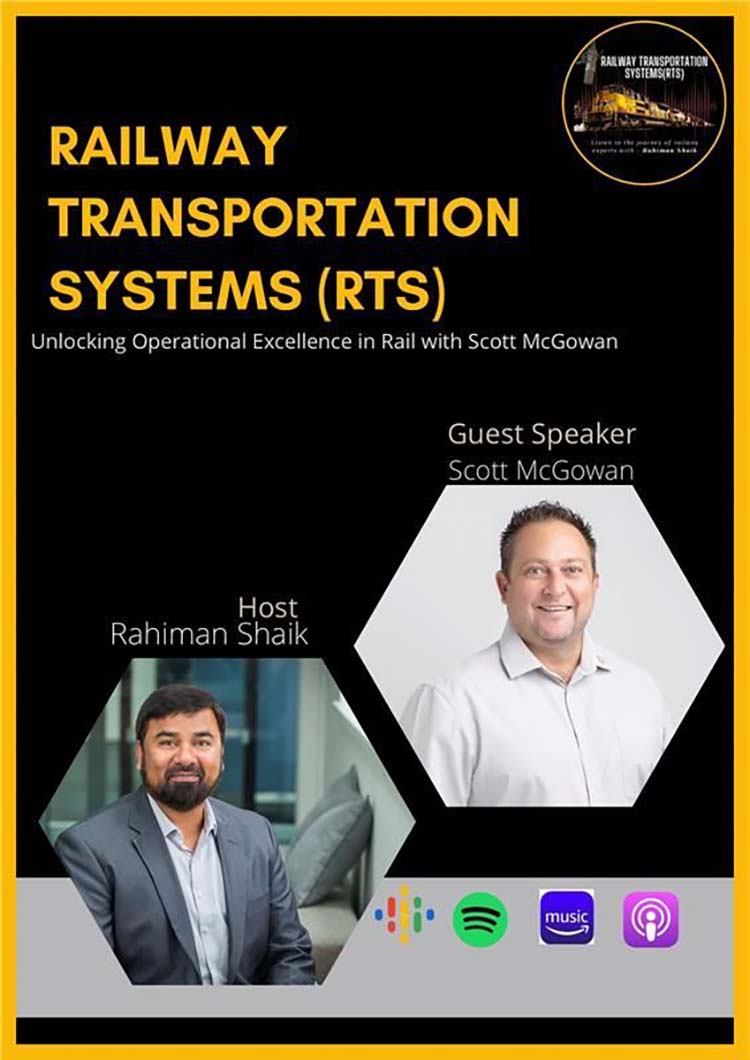
Scott McGowan, Managing Director and CEO of COSOL, recently joined the global Railway Transportation Systems Podcast to discuss how COSOL is helping the rail sector tackle real operational challenges.
In this interview, Scott shares how COSOL is making a difference in rail operations by integrating enterprise systems, improving asset management with mobility solutions and predictive analytics, and driving better customer experiences. He also discusses the potential of emerging technologies such as AI and automation, and how these tools can help rail operators move from reactive fixes to reliable, future-ready operations.
About Scott
Scott’s journey with COSOL began over twenty years ago, giving him a unique perspective on what works - and what doesn’t - when it comes to building reliable systems for critical industries.
With experience across both startups and global organisations, Scott understands the gap between business needs and technology solutions. He is passionate about leading teams that work closely with customers to turn complex problems into practical outcomes, especially where safety and reliability are non-negotiable.
About Rahiman
-
How does your experience from mining systems translate to the rail sector?
-
How do you ensure profitability while delivering these innovative solutions in the rail sector?
-
What opportunities do you see for rail infrastructure projects in that region?
-
How is COSOL helping rail companies achieve their environmental goals through technology?
-
How does COSOL stay ahead in providing solutions to the rail sector?
1. Could you share your journey to becoming the CEO of COSOL and how your background has influenced your leadership style?
Scott:
First of all, it's probably worthwhile starting with the history and pedigree of COSOL. COSOL originally stood for "Collaborative Solution Providers International," which was about how we do things with our customers to drive efficiencies and deliver value. We realised pretty quickly that the name was too long for our business cards and email addresses, so we shortened it to 'COSOL' to keep the intent and culture behind it while delivering a more efficient outcome for ourselves.
As for my journey to becoming CEO of COSOL, I actually came from a technical background. By trade, I'm a software developer. But I quickly realised there are lots of software developers who are really good at developing software, and I found my passion in the intersection between business and technology. I started to grow in my career by working with customers to articulate some of the challenges they were having in their industries and then turning that into requirements or specifications for technical people to build relevant software that would drive different outcomes for those businesses.
I really enjoyed not just solving those technical problems, but seeing how those solutions could change the way a business operates. That's probably shaped me into more of a hands-on and passionate leader. I understand the subject matter and the technical capabilities, and bringing those together really excites me when working with our customers. I like to be close to the work, close to our people, and make sure what we're doing with our technology actually delivers meaningful outcomes for our customers.
2. How does your experience from mining systems translate to the rail sector?
Scott:
Originally, we were born out of a mining background, but largely due to the GFC in about 2009-2010, we realised pretty quickly that we needed to diversify from a sector perspective.
One of the things we realised was common to our experience: managing large physical assets really differentiated us in the marketplace.
Things like aging assets, pressure to extend asset life, the need to extract more value from data, and bridging the gap between operations and technology are always common themes in those industries. Other industries such as finance and retail went through their digital transformation many years ago, but physical asset organisations - because of the large capital investment, slow-moving nature, and traditional way of operating - were a natural space for us to operate.
What's transferable is the complexity of managing large, dispersed asset bases and the demand for reliability and efficiency.
3. Can you tell us the key challenges you've observed in integrating enterprise systems like SAP and Ellipse within rail operations?
Scott:
I think one of the biggest challenges we see, particularly in rail, is that the systems have been built up over decades. These are large, monolithic enterprise systems that have typically been born out of a pedigree of one particular function over others.
The business context about how they provide value to customers is quite specific and really centered around an asset-centric approach. From our point of view, bringing SAP and Ellipse together means you've got to clean and standardise a lot of data, information, and processes. Otherwise, you don't get reliable insights.
Another hurdle is adoption. These are complex systems built for highly advanced users, and we find that a lot of organisations are looking for simplicity, particularly with varying skill levels in the workforce and varying degrees of education. Frontline teams don't want to make their jobs harder, so change management and training are just as important as the technology itself.
And of course, rail is safety-critical, so you can't afford disruption of operations while you're integrating. Understanding the business context and what they're trying to achieve is critically important. Finally, it's about striking the right balance.
4. How does COSOL approach the integration of SCADA systems with enterprise platforms in the rail industry?
Scott:
When we look at integrating SCADA with enterprise platforms in rail, the focus is always on business outcomes, not just the technology. A lot of people want to integrate things without understanding the value they're going to bring to the table.
SCADA gives you all this live operational data, but it's really about understanding the data that matters - or what we typically call "the metrics that matter."
- There's so much information and data, and they're analysing things and running all these analytical programs, but they actually get lost in the maze of data they create. Having a clear view of what you're trying to achieve with that data is really critical.
We approach it with a fairly layered architecture. We capture and cleanse the data at the edge. If you're talking about accurate data and the metrics that matter, you don't want to flow all of that information into big enterprise, monolithic systems like SAP and Ellipse without cleansing it to a certain extent and understanding what's real, what's noise, and what the impacts are. We capture that data, cleanse it at the edge, and map it into a standard data model.
You have to have that secure layer because once you start to go from the operational side and the process control networks into the IT world, if you can start to manage or push data back into those operational technology networks, it becomes quite serious in terms of the criticality of that information and what it can do to those assets.
What does it all mean ultimately from our point of view?
From our perspective, having that real-time data is critical, but having the right data, the right information at a point in time, and understanding the context is critical.
5. How does this acquisition benefit your rail sector clients?
Scott:
The acquisition of Toustone was a strategic acquisition that COSOL completed in December 2024. They specialise in data and AI-driven analytics, whereas COSOL specialises in assets and understanding the business outcomes and what they're trying to achieve.
The difference with the Toustone business is the intersection between the statutory authority, the asset owner, and the operator and maintainer, which is a new concept in public/private partnerships, particularly in Australia.
They've built this really unique capability and solution that leverages a native cloud environment with real-time data feeds that interact with customers all the way through to the assets and the contracts, linking all that together as a single pane of glass. I think that's the new way of working.
What we're seeing in rail now is as it starts to roll out that same public/private partnership model to other rail providers around Australia, it's becoming the gold standard. I think you'd agree...
if you've ever been on the Metro trains (in Sydney) - it's probably a shining light. It's one of the most successful autonomous rail projects, certainly in Australia but probably globally as well.
6. Can you discuss how COSOL is leveraging mobile technology to improve rail maintenance and operations?
Scott:
Mobility is one aspect of it, and it's definitely a benefit to rail operations. In COSOL, we're helping our customers move away from paper-based or desktop-heavy processes and putting some of those enterprise systems directly in the hands of field crews through mobile technology.
One of the experiences we had recently was the ability to capture data in the field. There was a rebuild going on, and a crack was detected. The photo was taken. What would have typically happened in the past is the work order would have been completed, the rebuild would have been completed, and that rolling stock would have gone back into production.
But actually, with that real-time feedback, it was identified that there was a crack detected in the structure, and the supervisor was able to make a decision right then and there to say, "Hang on, before we assemble this component back together, we should fix that." Without that, the maintenance worker would have reassembled the component, put it back together, raised the defect, and it would have gone through a process over time. Maybe in six months, we would have seen that end up as a work order again.
They've run around in vans or gone to yards and inspected things.
I think there's a much more customer-centric or customer experience way of doing things.
7. How do you ensure profitability while delivering these innovative solutions in the rail sector?
Scott:
From our point of view...
We aren't a "build it and they will come" type of organisation.
While we come up with a point of view and different solutions, a lot of the time we work with our customer base in a partnership model and we co-innovate together. I think that's really important.
We're not investing ahead hoping that things will happen in the future. We're not ahead of the curve. We're not an Apple or Google type of model. We're very much a customer relationship, customer partnership model where if it's not relevant to our customers, then we don't want to invest in it ahead of the curve.
It's just that balance of thought leadership with the relationship with the customer. We have that open transparency and know that some things might work and some things won't.
Our customers expect that, but they still want us to be in business as well. Everyone's got to make a profit. We help them reduce costs and get returns over time. They pay for the services and the value they receive.
8. Can you provide an example of a project where COSOL significantly improved operational efficiency for a rail client?
Scott:
The key one is off the back of the Toustone work, and we've been on that journey with Metro Trains Sydney from the very start. Even before it was operational, we were collecting asset data, collecting condition data, and putting the maintenance plans and strategies together for them to be able to operate their assets efficiently.
But ultimately with the Toustone overlay...
The ability to predict energy consumption from a real perspective using machine learning and data - whether that's external data, passenger historical trends, operational performance, production information, asset information, and bringing all that together - we're predicting energy consumption within 2 or 3% of actuals.
I think they contracted somewhere between 6 and 10%, so that's adding real value where they can make decisions around spot pricing or long-term contracts or whatever they might do to be much more efficient in their operations.
9. What opportunities do you see for rail infrastructure projects in that region?
Scott:
The US is an interesting market, particularly for us and the presence we have there. We talk in Australia about some of the numbers and the sizes of organisations, but when we're talking about the Federal Transit Administration, they spend $20 billion US annually for transit agencies.
It was originally set up as a one-time capital boost, but now it's critical to transit agencies for their survival. They have to justify that spend: where they're spending it, why they're spending it, and how they utilise their capital. That ability to understand how their assets are performing - whereas historically it's been provided almost as an operating expense - that justification as they start to become more commercial means they have to think about where they're spending the money, whether they want to buy new fleet, new rolling stock, pay for new infrastructure, whether it be signalling, etc.
We're seeing significant spend in that area and a significant need for data to be able to justify that spend to the federal agencies. Since 2012, they must report asset condition to the National Transit Database. This is again that information exchange - think about what I said before around that tripartite agreement between a statutory authority, an asset owner, and an operator and maintainer - bringing all that together and being able to report the state of good repair versus repair/replace.
All of that information has really set us up to become quite strong in the US. What we're seeing now is those initial projects kicking off where they're saying, "Actually, the first step is we just need to understand the condition of our assets before we worry about anything else." And there's a huge risk of funding loss without that strong asset visibility".
10. What role does predictive analytics play in COSOL's approach to asset management, especially in the rail industry?
Scott:
This is a really interesting topic and something I've had a lot of discussions about previously. I think one of the challenges we have, because of the safety criticality of the infrastructure and the assets in rail in particular, is that letting assets fail is not something we want to do.
Without failure information, it's very hard to learn.
If you think about predictive asset management, without that failure information, without that failure data and understanding the root cause, and then being able to understand the circumstances in which that asset failed, it's very difficult to move from a preventative - highly costly preventative - strategy to a predictive strategy.
What we can do is start to collate that information and provide insights and recommendations to those rail providers to predict potential failures. But I don't think it'll ever be adopted as a truly predictive failure model.
I think it's going to be more of a risk management play, and where those assets have potential to cause safety incidents for either employees or the public, I think that's going to take a long time for organisations to start to truly trust the data.
I think it all comes down to trust. What we're seeing now is we're probably on maybe level one of ten in terms of making sure we've just got the right data in a timely manner. Once data gets stale, it no longer becomes valuable. I think there's a lot of value there in terms of a real asset management approach or maintenance approach, but it's still going to require a lot of human decision-making to support that.
11. How is COSOL helping rail companies achieve their environmental goals through technology?
Scott:
From our point of view, we're about how we do things more efficiently with our customers. There are challenges around sustainability. If you think about Scope 1, Scope 2, Scope 3 from an ESG perspective, you need to make sure that your suppliers are also aligned to your ESG or sustainability goals.
Data just comes through in all of that from our perspective. We're doing a lot of work to understand and capture data around all the different scopes of that information. We capture a lot of energy-related data. If we talk about rail in particular - passenger rail - consumption is critical. If we can optimise that and provide forward-looking estimates to the government, where we can start to manage peak loads more effectively with the energy consumption that takes place, all of those aspects from a COSOL perspective are around energy prediction.
We're very confident now with our energy prediction model for our customers. It's about understanding the vendor landscape all the way through, all the way back for us. Ultimately, it's about making sure there's no wastage - eliminating waste without compromising reliability, safety, and regulatory and statutory aspects. That's where the value that COSOL brings to the table.
We can save energy, we can save costs, and make sure that workers are safe and the public is safe as part of that.
12. How do you, as a CEO, make sure that they collaborate - both technical teams and business stakeholders?
Scott:
I think that's one of the biggest challenges we face. I went to a conference only two weeks ago where the answer to everything was AI, and I'm thinking, "What's the solution? What's the question?"
I think the reason COSOL is the way it is, is because we said we're going to be specialists in asset management. When I talk about asset management, I talk about assets, work management, inbound supply chain, and costing. They're all tightly integrated processes. Having that context and focusing on that particular area and then being deep and vertically integrated from a business point of view is the only way to do it.
Going forward, the generic views of technology providers or systems integrators - I think those times are of the past. I think they will continue to do the lower-level generic things.
Industry-specialised, vertically integrated businesses like COSOL, where we've got a very clear subject matter that we focus on and everyone in the business understands what we're trying to achieve - that's the secret to bringing business and technology together.
Quite frankly, I'm sure there are other technologists who understand more things than our team does, but our team understands the business context in which they're applying the technology. And that is critical.
Scott:
We combine that industry expertise with a strong focus on innovation. Innovation is part of our culture. It's what we engage with our business to do. We have structures and processes in place. We continually monitor emerging technologies. We work with and provide use cases to our customers. We then invest with our customers to identify whether or not that's something that's applicable and evaluate how it delivers value.
13. How does COSOL stay ahead in providing cutting-edge solutions to the rail sector?

We're almost pseudo-building the business case with them along the way. But it's through partnerships, through acquisitions, through in-house development - we bring new capabilities to our customers quickly.
We're ready to fail though, and I think with our customers, we've got to be ready to fail with new technologies. Some things work; some things don't. However,
14. What emerging trends or technologies do you believe will have the most significant impact on rail transportation systems?
Scott:
I wish I had a crystal ball because if I was investing in that now, I probably wouldn't have to work in the future. But if I look ahead now and understand what's in the immediate future, I'd say there are several emerging trends that are set to transform rail transportation.
Everyone's going to say this, and I have to say it as well: AI will make an impact. But I don't think it's going to replace jobs - I truly don't believe that. I think there's going to be AI-savvy people and AI non-savvy people, and the AI-savvy people will utilise AI to make themselves more productive and therefore more valuable and more industry-focused. But I don't think it's going to replace jobs. I really do think we're in the infancy. I think we're many years away.
We've got to invest time back into the models themselves. Just like we have an apprentice on a site, we've got to explain what they're doing wrong. We've got to explain when mistakes are made, and then we've got to continually teach. I think that's going to take time to get that trust in AI. But it is going to impact predictive maintenance. I think preventative maintenance and predictive maintenance will evolve over time.
Probably more importantly is this new way of thinking about customer first or customer centricity.
It is a public service, and in a lot of circumstances, it's public infrastructure - whether it's doing commodity movements or bulk, etc., from a rail perspective - it's still a customer service. I really think that customer experience, stakeholder experience, will become a very important part of the rail industry.
I think digital twins and the ability to see those things together are going to impact it.
But my honest belief in the next 12 months is it's about automation. How do you lean out non-value-added tasks? How do you remove wastage within those organisations?
Honestly, for the rail industry in particular, a lot of the organisations are 100-plus-year-old organisations. They are old organisations - Metro Trains Sydney, not so much - but they've been around for a long time. There's a lot of money going into that infrastructure.
I hear a lot of "Well, that's the way it's always been done." I think that automation and elimination of manual tasks will be the first phase over the next 12 to 18 months. But from our point of view, we're just going to continue to innovate with our customers.
Basically, any new solution must enhance safety, network performance, and operational continuity, because in rail, failure is not an option.
