
At a glance
- Most organisations use Maximo as a work order system, missing advanced capabilities like Health, Monitor, and Predict.
- COSOL aligns Maximo with ISO 55000 across six areas: value realisation, alignment, leadership, risk, lifecycle, and continuous improvement.
- Data quality is the primary blocker - clean, structured data is non-negotiable before advanced analytics deliver value.
- Success requires strategic implementation, not more technology - you already own the platform, you need the right expertise.
How to transform your Maximo investment from basic deployment into a strategic asset management platform that delivers measurable business value.
You've invested in IBM Maximo Application Suite. Perhaps hundreds of thousands of dollars in licensing. Months of deployment effort. Training programmes. Integration projects.
And yet, if you're honest, you're probably using it as an expensive work order system.
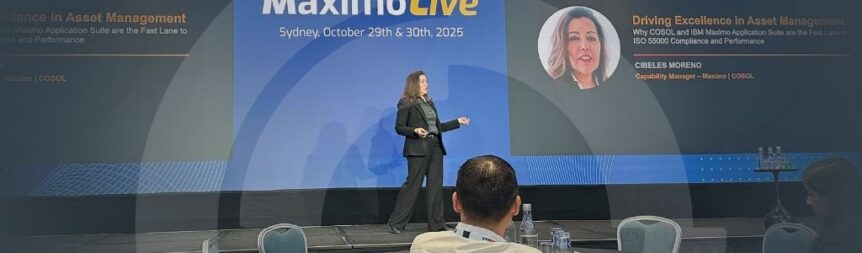
At Maximo Live, Cibeles Moreno, Asset Management Specialist at COSOL with over 20 years of experience, presented a framework at Australia's inaugural MaximoWorld expo held in Sydney, for how organisations can maximise their return on Maximo investment by aligning it with ISO 55000 asset management principles. Her message was clear:
Why You're Stuck in Traffic
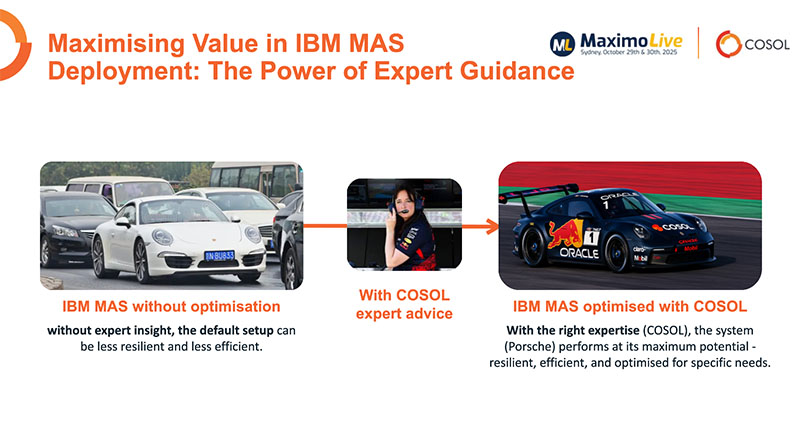
The reality for most asset-intensive organisations is that Maximo serves as little more than a work order management system or, worse, a data repository.
Cibeles shared an example that will sound familiar:
This pattern plays out everywhere:
- Maximo gets deployed for work orders, but asset hierarchies remain poorly structured
- Monitor capabilities exist but aren't integrated with SCADA or historian data
- Predict sits unused because no one established the failure models
- Health could identify asset deterioration, but condition data isn't being captured
- Dashboards show generic metrics instead of strategic KPIs aligned to business objectives
The core issue isn't the technology - it's that Maximo was implemented as an IT project rather than an asset management transformation programme.
The gap between basic deployment and strategic implementation is where organisations like COSOL provide value -not by selling you more software, but by helping you unlock what you already have.
The Roadmap: ISO 55000 as Your Navigation System
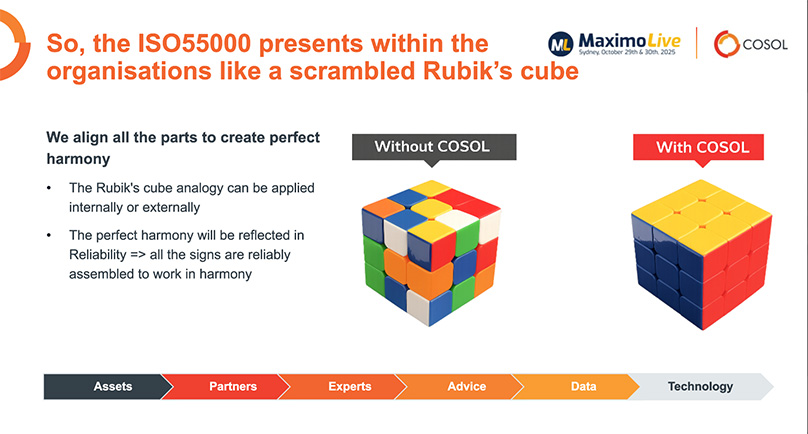
The Six Areas - And How Maximo Delivers Each
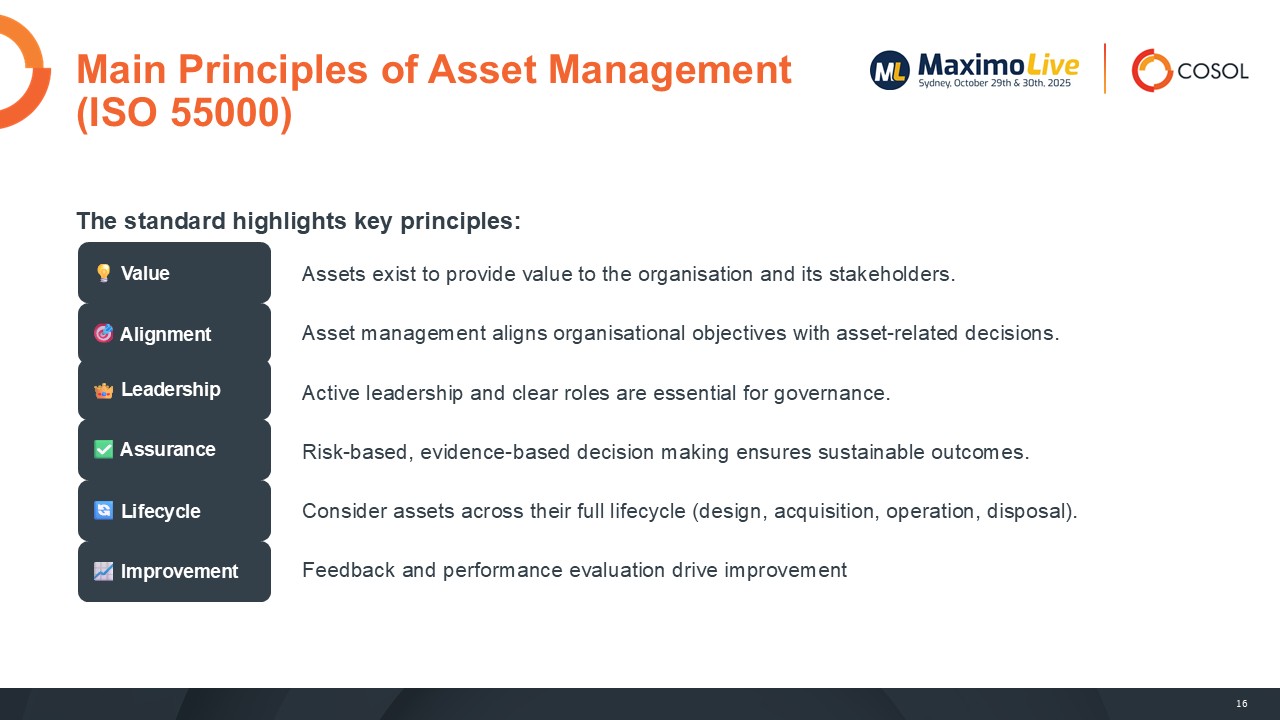
What it means: Understanding and maximising the value your assets deliver to the organisation.
How Maximo delivers it: Asset Performance Management (APM) combines Health, Monitor, and Predict to give visibility into how assets are actually performing. "We combine Health, Monitor, and Predict and we have a way to measure what is the asset performance management. And now we can also use the Asset Investment Plan, and we can start looking into those models."
What it means: Ensuring asset management activities align with corporate strategy and stakeholder expectations.
How Maximo delivers it: Work order management, asset hierarchies, location structures, and operational planning through Maximo Manage. "When we connect Manage, it's doing all the work order management, doing all that support. We can see, we can align what we're trying to achieve."
What it means: Securing executive support and establishing clear accountability.
How Maximo delivers it: Executive dashboards that translate technical data into business metrics keep leadership engaged. "Until you get that support from above, you don't move," Cibeles emphasised. "Even if you have the best ideas in the world, if they are not aware of it or they are not supporting you, it's very hard."
What it means: Systematically identifying and mitigating risks across the asset portfolio.
How Maximo delivers it: Maximo Predict includes a reliability library that was once only available in specialised tools like Meridium. "It was the first time a bunch of scientists in America decided to start looking at every single asset... How does it fail? When does it fail? What do I need to do to prevent that failure? Now it's part of Predict, it's part of Maximo, which makes life easier." This is particularly valuable for smaller organisations that lack the historical data or expertise to develop failure models from scratch.
What it means: Managing capex and opex across the full asset lifecycle, from planning through decommissioning.
How Maximo delivers it: Asset Investment Planning and Linear Asset Management capabilities are essential for organisations managing distributed infrastructure—pipelines, roads, rail networks. "You have kilometres and kilometres of pipe, and that is so important to know because when a pipe bursts, it's not only reputation, it's service, it's asset performance."
What it means: Establishing feedback loops and KPIs to drive ongoing optimisation.
How Maximo delivers it: Analytics capabilities enable the measurement and tracking essential for continuous improvement cycles.
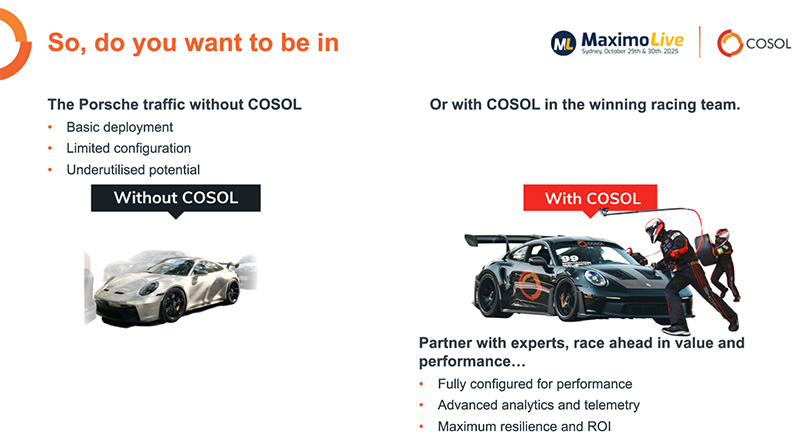
The Pit Crew: What COSOL Actually Does
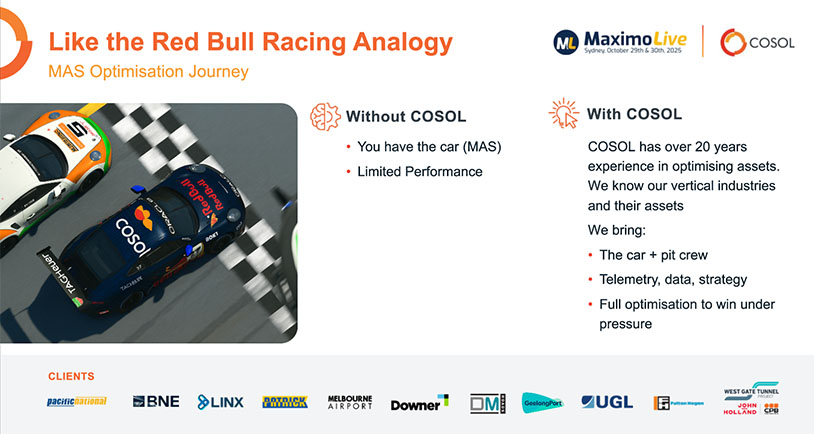
Generic Approach:
- Configure out-of-the-box functionality
- Deploy Maximo Manage for work orders
- Basic user training
- Generic reporting
Result: System works, but provides limited strategic value
COSOL's approach:
- Map your asset management strategy to system configuration
- Define asset and location hierarchies that reflect how you actually manage assets
- Integrate advanced modules (Health, Monitor, Predict) with existing systems
- Build industry-specific dashboards tied to regulatory and business requirements
- Establish data governance frameworks
- Create failure models specific to your asset base
- Configure linear asset management for infrastructure networks
- Align everything to ISO 55000 principles
What works for transport doesn't work for water utilities. What works for water doesn't work for manufacturing. COSOL brings vertical specialisation across transport, water, defence, and other asset-intensive sectors.
For example, water utilities face unique pressures: stringent regulations (Victoria's Safe Drinking Water Regulations updated July 2025), ageing infrastructure requiring strategic replacement, geographic challenges (in NT, only 63% have access to reticulated water), and public accountability. The ISO 55000/Maximo alignment for water utilities specifically addresses water security through Monitor integration with SCADA, regulatory compliance through automated workflows, linear asset management for pipeline networks integrated with GIS, and risk management using Predict to identify high-consequence failure scenarios.
ISO 55000 provides the governance framework, while MAS delivers the enabling digital tools.
| ISO 55000 Element | Water Utilities Example | MAS Capabilities |
|---|---|---|
| Policy & Strategy | Align asset management with water security, regulatory compliance (e.g., EPA, Safe Drinking Water Act), and service reliability. | MAS Manage supports strategic objectives through asset classes (pipes, pumps, treatment plants) and service KPIs. |
| Value Realisation | Ensuring safe, continous water delivery, environmental compliance, cost efficiency. | MAS Health scores show asset contribution to service, Monitor enables telemetry from SCADA/IoT for real-time performance. |
| Leadership & Governance | Transparent reporting to boards, regulators, and customers | Role-based dashboards, governance workflows, compliance logs. |
| Risk Management | Pipe bursts, pump failures, water quality incidents, environmental breaches | MAS Predict forecast failures; Health risk scoring prioritises high-risk assets. |
| Lifecycle Management | From pipe installation through renewal/replacement. | MAS linear asset management & renewal planning; Job Plans + PMs for treatment facilities. |
| Continous Improvement | Optimising maintenance strategies to reduce unplanned outages | MAS analytics, KPIs, and AI-driven recommendations for strategy review. |
| ISO Clause | ISO Clause Description | Water Utilities Example | MAS |
|---|---|---|---|
| 4 | Context of the Organisation | Define hierarchy: catchments → treatment plants → reservoirs → pump stations → pipe networks → meters | Asset hierarchies, Locations, Linear Assets module |
| 5 | Leadership | Regulators demand reporting on compliance breachers | Workflow approvals, compliance reporting dashboards |
| 6 | Planning | Long-term pip renewal programs, capacity upgrades, drought-response planning | Capital planning with Health condition indices and Predict failure forecasts |
| 7 | Support | Staff qualifications (confined space, chemical handling) | Certifications and Qualifications module; AppPoints role application |
| 8 | Operation | Daily operation of water treatment plants and pumping stations | Work Orders, Job Plans, Mobile Technician A |
| 9 | Performance Evaluation | Leakage targets, unplanned outage minutes, compliance with safe water standards | KPIs, SLAs, Dashboards |
| 10 | Improvement | Reduce NRW (Non-Revenue Water), optimise pump efficiency | Analytics, AI insights, continuous KPI monitoring |
COSOL customers in this space include Unitywater, Power and Water Corporation, Goulburn-Murray Water, Wannon Water, and TasWater. Cibeles and the team at COSOL are currently running an APM proof of concept with one of our customers.
This accumulated knowledge - built across 20+ years and dozens of implementations- means organisations aren't starting from scratch. They're leveraging patterns that have proven successful in similar environments.
The Primary Blocker: Data Quality
Cibeles was candid about where implementations typically stall: "Data quality and readiness. How many people have so many issues with data?"
Without clean, structured data, sophisticated analytics are worthless. The organisation using Maximo as a "database dump" spent months cleaning data before any advanced capabilities could be implemented.


Change Management
(Culture and Leadership)

Integration Complexity
(ERP, GIS and IoT)

Data preparation requirements:
- Asset hierarchy definition and standardisation
- Location structure rationalisation
- Historical data cleansing and migration
- Integration with source systems (SCADA, GIS, financial systems)
- Data governance frameworks to maintain quality
This work isn't optional. "Once we get that, the rest will flow very quickly," Cibeles noted. But trying to skip this step guarantees failure.
The lesson: data preparation isn't glamorous, but it's the foundation that makes everything else possible. Organisations should expect to invest significant effort upfront -but those with experience can accelerate the process through templated approaches.
Your Path Forward
For organisations looking to move beyond basic deployment, Cibeles outlined a pragmatic approach:
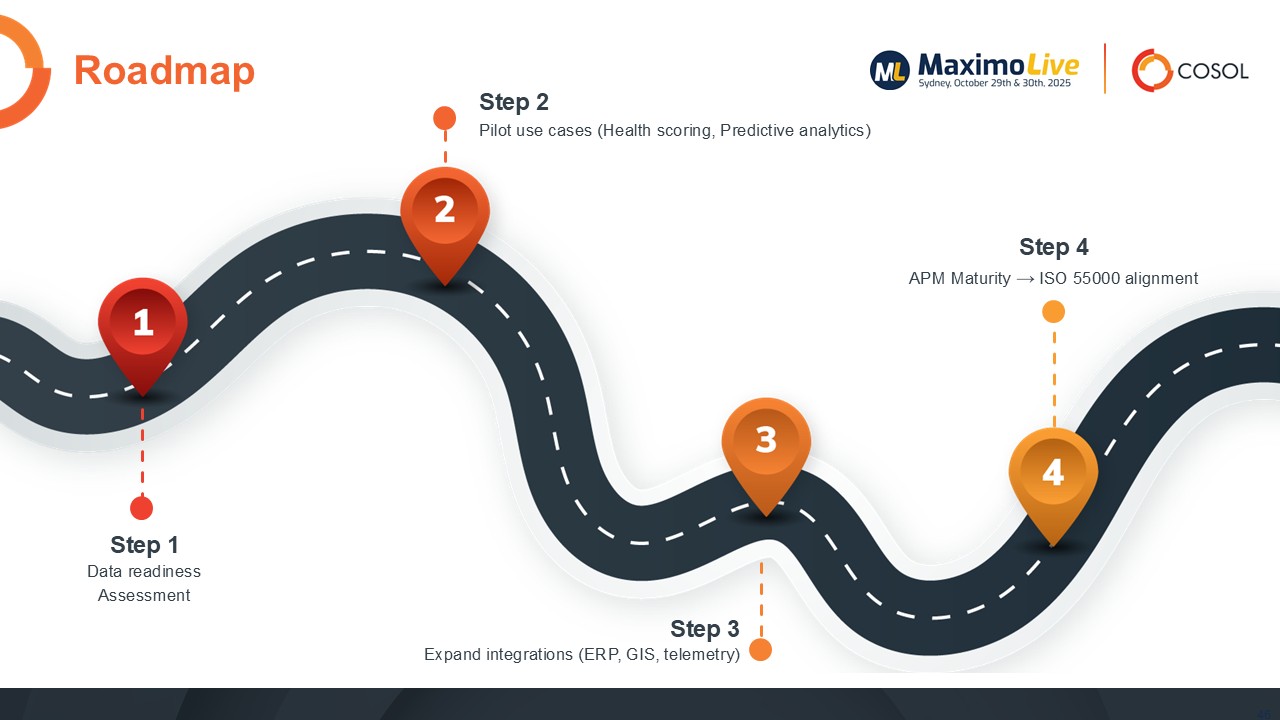
Phase 1
Prepare the Data
Phase 2
Develop Proof of Concept
Phase 3
Build Maturity
Phase 4
Align to ISO 55000
What Success Looks Like
Cibeles concluded with four clear outcomes organisations should expect from a properly implemented Maximo platform aligned to asset management principles:
- Maximise value - Extract more performance and longevity from existing assets
- Mitigate risk - Identify and address failure scenarios before they occur
- Boost performance - Optimise maintenance strategies and resource allocation
- Ensure compliance - Demonstrate adherence to regulatory requirements

Get Out of Traffic
Most organisations have already made the significant investment in Maximo Application Suite. The platform has the capabilities to deliver sophisticated asset performance management, predictive analytics, regulatory compliance, and strategic decision support.
The gap between potential and reality isn't a technology problem - it's a strategy and implementation problem.
For asset managers sitting on underutilised Maximo implementations, the message is straightforward: you already have the platform. The question is whether you have the expertise and framework to unlock its full potential. The fastest path to ISO 55000 alignment and measurable performance improvement isn't buying more technology -it's properly implementing what you already own.
As Cibeles put it: